PB Ch 37. Somatic Hybridization
1.1 Introduction and Definition
- Somatic hybridization is the fusion of protoplasts (plant cells whose cell walls have been enzymatically removed) from two different plant species to produce a hybrid cell, which is then regenerated into a complete hybrid plant.
- Because this involves somatic (vegetative) cells rather than sexual gametes, it entirely bypasses all pre-fertilization sexual incompatibility barriers.
- The method was first demonstrated by Carlson et al. (1972), who produced the first interspecific somatic hybrid from Nicotiana glauca × N. langsdorffii.
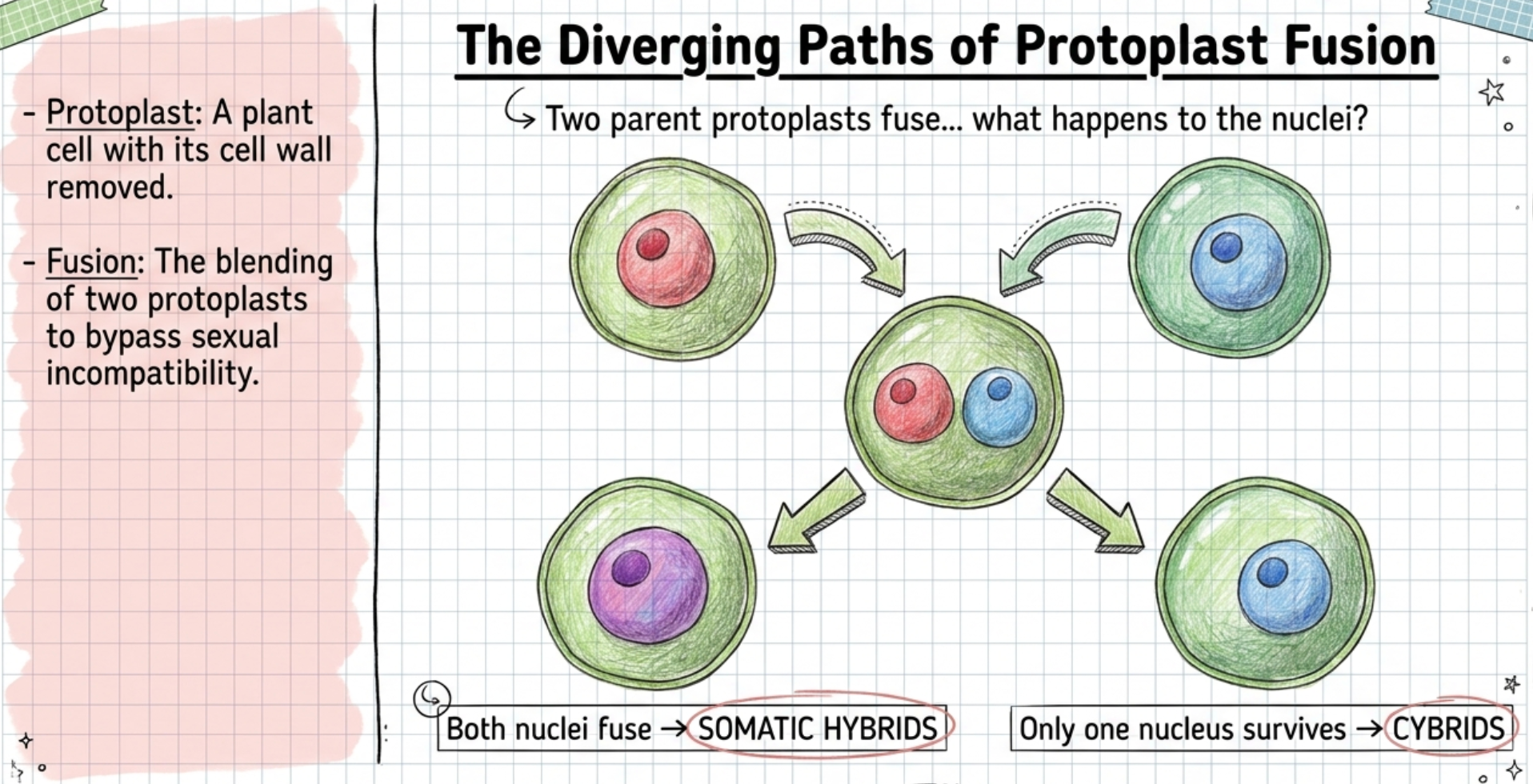
1.2 Steps in Protoplast Fusion
Step 1: Protoplast Isolation
- The plant cell wall must be removed enzymatically to release the naked protoplast. The enzymes used are cellulase (to degrade cellulose wall) and pectinase (to degrade pectin in the middle lamella and cell wall). The digestion is carried out in an osmotically balanced solution (usually 0.3–0.8 M mannitol or sorbitol) to prevent osmotic rupture of the naked protoplast.
- After enzymatic digestion, protoplasts are released and purified by filtration (to remove cell debris) followed by density gradient centrifugation (using sucrose or Percoll gradient) to obtain clean, viable protoplasts.
Step 2: Protoplast Fusion
The isolated protoplasts from the two species are mixed and fusion is induced by one of two methods:
- Chemical Fusion (PEG method): Polyethylene glycol (PEG) is the most commonly used chemical fusogen. PEG causes protoplast aggregation and membrane destabilisation; addition of high pH Ca2+ solution after PEG triggers membrane fusion. The method gives moderate fusion frequencies and is simple and reproducible. PEG concentration typically used is 30–50%, combined with elevated pH (pH 9.0–10.5) and CaCl2.
- Electrofusion: Developed by Senda (1979). An alternating current (AC) electric field is applied to the protoplast suspension, causing the protoplasts to align in chains (pearl chain formation) perpendicular to the AC field. A brief, high-voltage direct current (DC) pulse is then applied — this creates transient pores in the membranes of adjacent aligned protoplasts, allowing membrane fusion. Electrofusion gives higher and more reproducible fusion frequencies than PEG and causes less cellular damage. It is now the preferred method for efficient somatic hybridization.
Step 3: Selection of Hybrid Cells
Not all cells in the fusion mixture form hybrids — unfused cells of either species, homokaryon fusions (two cells of the same species), and true heterokaryon hybrids (one cell of each species) all coexist. Selection of true hybrids is critical. Methods include:
- Complementation selection: Two mutant cell lines each lacking a different essential function are used. Only heterokaryon fusions restore both functions — the others cannot grow on selective medium.
- Fluorescent dye labelling: One species' protoplasts are stained with a red fluorescent dye and the other with a green dye. True hybrids fluoresce both colours under the microscope and can be manually picked under fluorescence microscopy or sorted by flow cytometry.
- Drug resistance markers: One parent is resistant to one antibiotic, the other to a second. True hybrids grow on medium containing both antibiotics; homokaryon fusions are killed.
Step 4: Culture and Regeneration
- Selected hybrid cells (heterokaryons) are cultured on nutrient medium. The protoplast reforms its cell wall within 1–3 days; cell division follows, forming a callus mass.
- The callus is then transferred to a regeneration (shoot differentiation) medium containing appropriate ratios of cytokinin (BAP) and auxin (NAA or IBA).
- Shoots are induced, then rooted on hormone-free or low-auxin medium, and the regenerated plants are hardened and transferred to the greenhouse or field.
Step 5: Confirmation of Hybrid Nature
The regenerated plants must be confirmed as true somatic hybrids by:
- Chromosome count: The somatic hybrid should have the chromosome number of both parents combined (amphidiploid if both parents were diploid).
- Isozyme analysis: Hybrid should show isozyme bands of both parents.
- Molecular marker analysis: RFLP, SSR, or SNP markers can confirm the presence of both parental genomes in the hybrid.
- Morphological observation: Hybrids often show intermediate morphology between the two parents, though this is not always reliable.
1.3 Types of Products from Protoplast Fusion
A. Somatic Hybrids
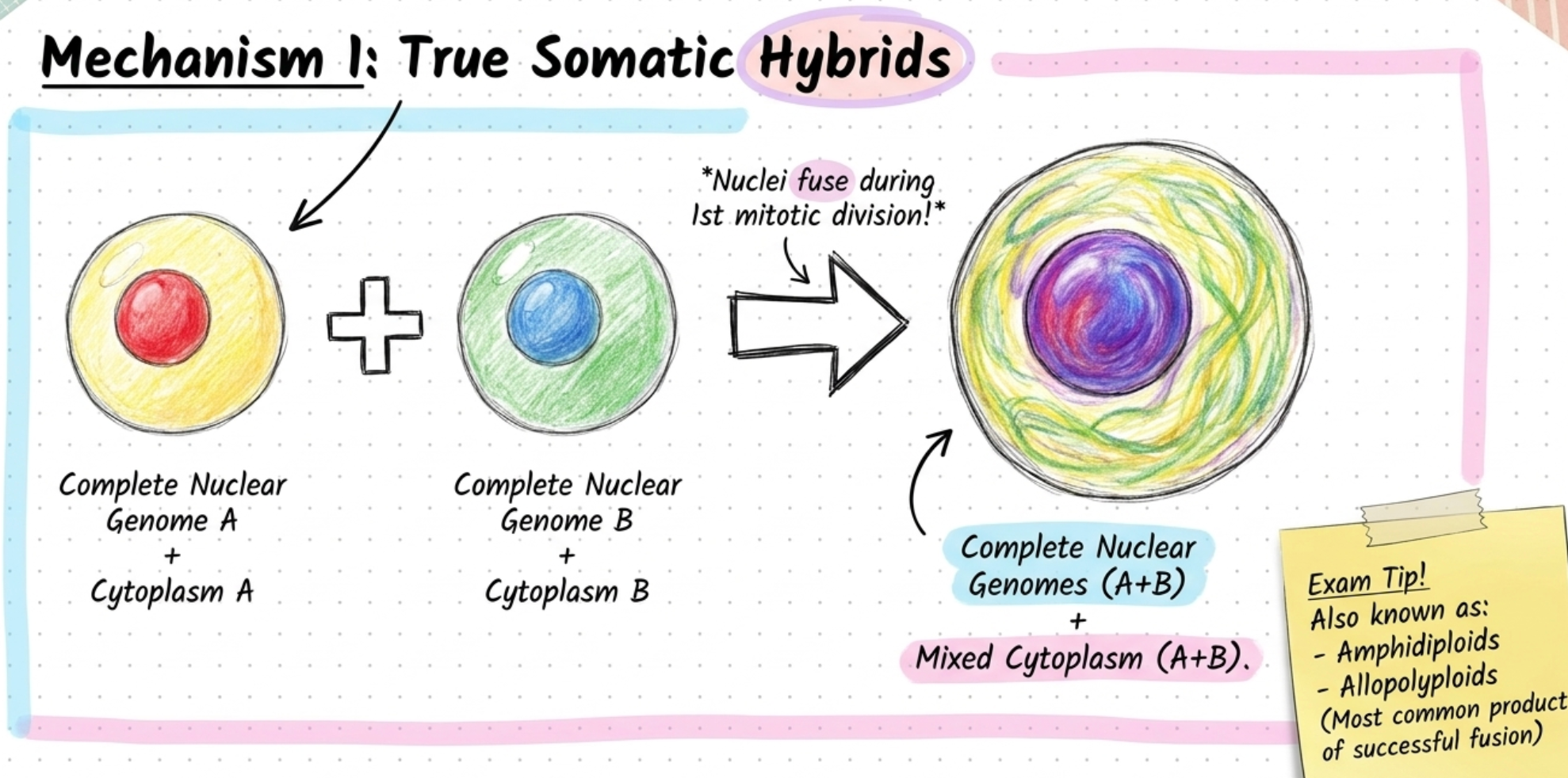
- When two protoplasts fuse and both nuclei from the two parent species fuse together during the first mitotic division, the resulting plant contains the complete nuclear genomes of both parents plus cytoplasm from both.
- These are true somatic hybrids — also called amphidiploids or allopolyploids in the context of somatic hybridization. They have nuclear material from both parents and are the most common product of successful protoplast fusion.
- Example: Pomato — somatic hybrid between potato (Solanum tuberosum) and tomato (Lycopersicon esculentum). The Pomato had leaves intermediate between potato and tomato, produced small fruits, and formed small tubers. It demonstrated the principle of somatic hybridization across distantly related species. It was NOT commercially viable — either the tubers or the fruits alone would be useful, but the plant produces neither in sufficient quantity.
B. Cybrids (Cytoplasmic Hybrids)
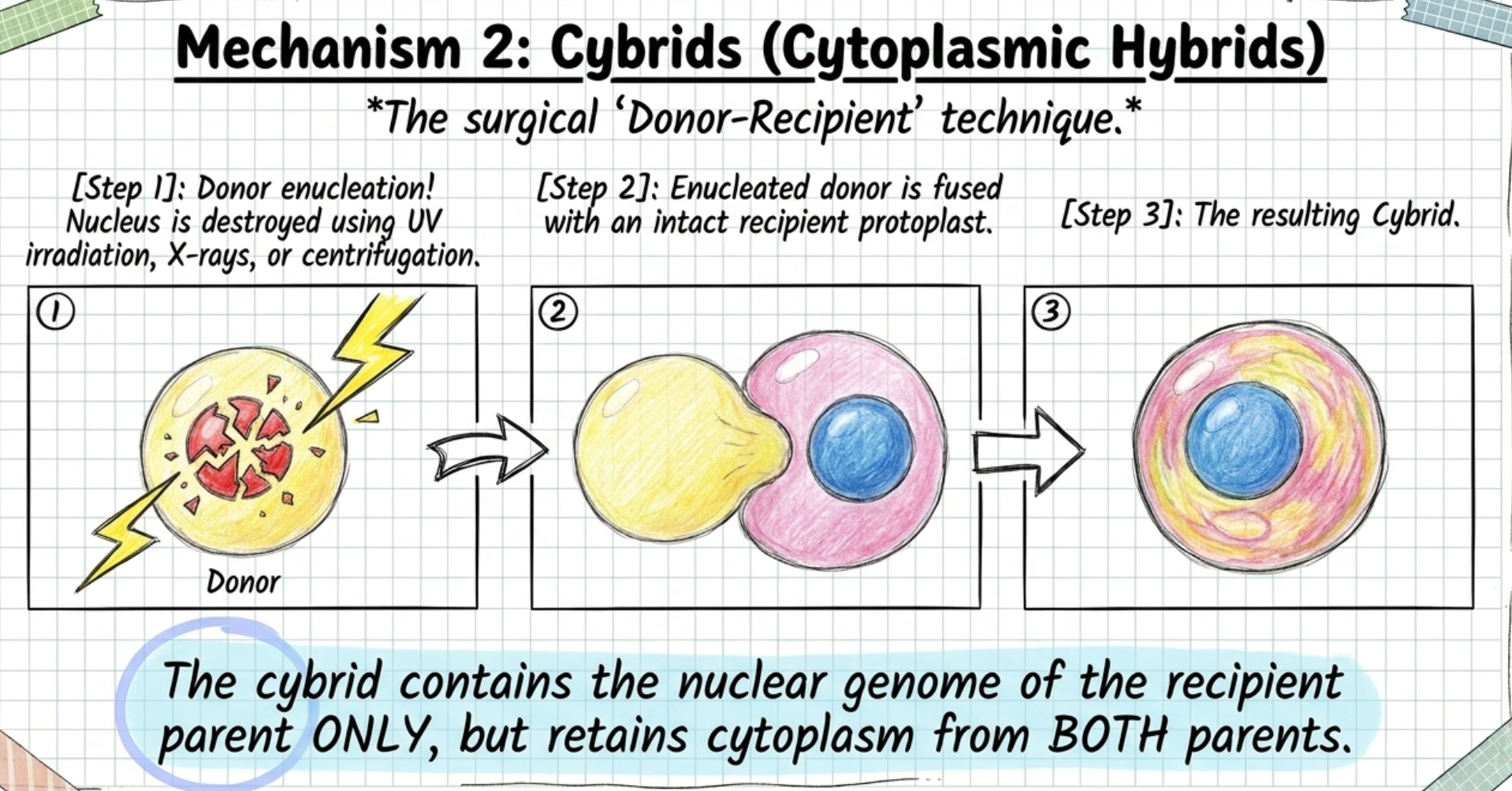
- When two protoplasts fuse but only the nucleus of one parent (the recipient) survives while the cytoplasm of both parents is retained in the fused cell, the resulting plant is a cybrid.
- The cybrid contains the nuclear genome of the recipient parent and cytoplasm from both parents.
- Cybrids are produced deliberately through the 'donor-recipient' fusion technique: one protoplast (the donor) is enucleated (its nucleus destroyed by UV irradiation, X-rays, or centrifugation) before fusion with the intact recipient protoplast.
- The resulting fused cell has the recipient's nucleus plus cytoplasm from both species.
Significance of cybrids:
- CMS transfer: The most important practical application. CMS (cytoplasmic male sterility) is encoded in the mitochondrial genome — which is cytoplasmic. Cybrids allow transfer of CMS cytoplasm from one species to another, even across sexual incompatibility barriers, without bringing along the entire donor nuclear genome.
- Herbicide tolerance: Atrazine tolerance (encoded in the chloroplast genome) has been transferred between Brassica species via cybridization.
Most important example — Ogu-INRA CMS transfer in Brassica:
- The Ogura CMS system was originally discovered in Raphanus sativus (radish). It causes complete male sterility. To transfer this CMS system into Brassica napus (oilseed rape) for commercial hybrid seed production, protoplast fusion was used to create cybrids of B. napus with the Raphanus cytoplasm.
- These cybrids showed the Ogura male sterility in the B. napus nuclear background. This was a major breakthrough — it enabled commercial production of hybrid oilseed rape without hand emasculation. The Ogu-INRA CMS system is now widely used in hybrid rapeseed breeding in Europe.
Somatic Hybrids vs Cybrids
|
Feature |
Somatic Hybrid |
Cybrid |
|
Nuclear genome |
From BOTH parents (amphidiploid) |
From ONE parent (recipient) only |
|
Cytoplasm |
Mixed — from both parents |
Mixed — from both parents |
|
Chromosome number |
Usually sum of both parents |
Same as recipient parent |
|
How produced |
Normal protoplast fusion |
Donor protoplast enucleated before fusion; or spontaneous nucleus elimination |
|
Main use |
Creating new species combinations; wide crosses |
Transferring CMS cytoplasm across barriers; herbicide tolerance via chloroplast |
|
Key example |
Pomato (potato + tomato) |
Ogu-INRA CMS in B. napus (Raphanus cybrid) |
1.4 Advantages of Somatic Hybridization over Sexual Hybridization
|
Somatic Hybridization |
Sexual Hybridization |
|
Overcomes pre-fertilization barriers (pollen-stigma incompatibility) |
Limited by fertilization barriers; pollen must germinate and grow |
|
Transfers nuclear + cytoplasmic genes simultaneously |
Cytoplasmic genes inherited from mother only (maternal inheritance) |
|
Works for vegetatively propagated species where seed production is difficult |
Requires functional gametes and seed development |
|
Can produce cybrids for CMS transfer across sexual barriers |
CMS transfer requires extensive backcrossing and is impossible across wide crosses |
|
Exploits wide cross combinations not achievable sexually — e.g., potato + tomato |
Limited to sexually compatible species or close relatives |
|
Both parents contribute cytoplasmic genomes (chloroplast + mitochondria) |
Chloroplast usually from mother; mitochondria from mother in most species |
1.5 Limitations of Somatic Hybridization
- Regeneration difficulty in cereals: The most critical limitation. Protoplast isolation and regeneration is extremely difficult in major cereal crops (rice, wheat, maize). Advances have been made in rice protoplast regeneration, but wheat and maize remain largely recalcitrant to somatic hybridization. This limits the practical application of this technique in the most important food crops.
- Amphidiploid problems: Somatic hybrids between distantly related species are often amphidiploids. Like amphidiploids from sexual crossing, these may show fertility problems, undesirable traits from the wild parent, and cytogenetic instability.
- Gene silencing and instability: Somatic hybrids sometimes show unexpected gene silencing (one or both parental genomes partially inactivated) and epigenetic instability, making prediction of hybrid phenotype difficult.
- Unpredictable cytoplasm composition: In cybrid production, the exact composition of the mixed cytoplasm (whether chloroplasts come from donor or recipient, and in what proportion) is not always controllable or predictable.
- Labour-intensive and costly: Protoplast isolation, culture, fusion, selection, and regeneration require sophisticated laboratory facilities, skilled personnel, and considerable time.
- Agronomic value not guaranteed: Many somatic hybrids produced so far have been of scientific interest (demonstrating the possibility of combining genomes) rather than direct agricultural value. The Pomato is the classic example of a scientifically successful but agronomically useless somatic hybrid.
1.6 Successful Applications of Somatic Hybridization
|
Combination |
Purpose/Goal |
Outcome / Status |
|
Nicotiana glauca × N. langsdorffii |
First interspecific somatic hybrid (Carlson 1972) |
Demonstrated the concept; plants were viable; scientific milestone |
|
Solanum tuberosum + Lycopersicon esculentum (Pomato) |
Wide cross between potato and tomato |
Produced; showed features of both; no commercial value; scientific proof of concept |
|
Brassica napus + Raphanus sativus (Ogu-INRA cybrid) |
Transfer of Ogura CMS cytoplasm to B. napus for hybrid rapeseed production |
Commercial success; Ogu-INRA CMS rapeseed hybrids grown in Europe |
|
Solanum tuberosum + S. brevidens |
Transfer of PLRV (Potato Leafroll Virus) resistance from S. brevidens |
Partial resistance transferred; research value demonstrated |
|
Citrus sp. + Poncirus trifoliata |
Rootstock improvement; cold hardiness from Poncirus |
Some success in rootstock development; nucellar embryony exploited |
|
Solanum tuberosum + S. melongena (potato + brinjal) |
Disease resistance transfer |
Research stage; limited commercial progress |
|
Nicotiana tabacum cybrids |
CMS transfer for commercial tobacco hybrid production |
Used in some hybrid tobacco programmes |
EXAM ANGLE: When asked about somatic hybridization, always cover:
|