PB Ch 26. GCA and SCA
- When plant breeders create dozens of pure, inbred lines, they face a massive puzzle: how do they know which lines will cross together to create the best possible hybrid?
- You can't just look at two weak inbred lines and guess that their offspring will be a super-plant. You have to test them. In 1942, scientists Sprague and Tatum (studying maize) formalized this process by defining the concept of Combining Ability.
- Combining ability measures how well a specific genetic line "plays with others." It is broken down into two distinct categories:
1. General Combining Ability (GCA)
- GCA is the average performance of a specific inbred line when it is crossed with a wide variety of other lines.
- The Genetics: GCA is driven by "additive genetic variance"—meaning the plant has inherently good genes that steadily add value, regardless of who it mates with.
- The Analogy: Think of a player with high GCA as a superstar team player. No matter what team you put them on, they elevate the average performance of the team.
- The Use Case: High GCA lines are perfect for creating Synthetic Varieties (where many lines are mixed together) and for the initial screening stages to weed out terrible lines. GCA is a property of a single LINE.
2. Specific Combining Ability (SCA)
- SCA is the excess or "bonus" performance of a specific, unique cross that goes above and beyond what you would expect based on the GCA of the two parents.
- The Genetics: SCA is driven by "non-additive genetic variance" (dominance and epistasis). This means the specific combination of genes between Parent A and Parent B triggered a unique, synergistic chain reaction.
- The Analogy: Think of two basketball players who are only average on their own (low GCA), but when they play together, they have a psychic connection and become unstoppable.
- The Use Case: High SCA crosses are the holy grail of commercial hybrid breeding. SCA is a property of a specific CROSS.
How Breeders Estimate Combining Ability
If a breeder has 50 new inbred lines, testing every single possible combination is often mathematically impossible. Instead, they use specific statistical designs to test the lines efficiently. Here are the five primary methods:
A. The Top Cross Test (The Broad Net)
- Used heavily for initial screening (pioneered by Jenkins in 1935). A breeder takes their new inbred lines and crosses all of them with a "tester" (usually a broad, generic open-pollinated variety).
- How it works in maize: The breeder plants alternate rows of the inbred and the tester. The inbred row is detasseled (male parts removed) so it can only receive pollen from the tester.
- The Goal: It provides a highly reliable estimate of GCA. If an inbred line produces terrible offspring with a generic tester, it is thrown out. This eliminates about 50% of the starting lines.
B. The Polycross Test (The Open Mingle)
Commonly used for forage crops (like grasses and alfalfa) where manually crossing individual tiny flowers is a nightmare.
- How it works: Several selected lines are planted together in an isolated field and allowed to naturally open-pollinate with each other. The seeds from each individual line are then grown out and evaluated.
- The Goal: Because each plant was pollinated by a random sample of the whole field, the progeny's performance provides a great estimate of that line's GCA.
C. The Diallel Cross (The Gold Standard)
- Developed by Griffing in 1956, this is the most comprehensive (and exhausting) method. Every parent is explicitly crossed with every other parent. It provides absolute data on both GCA and SCA.
- Because doing every single cross (and reverse cross) is incredibly time-consuming, Griffing broke it down into four methods based on the number of parents (n):
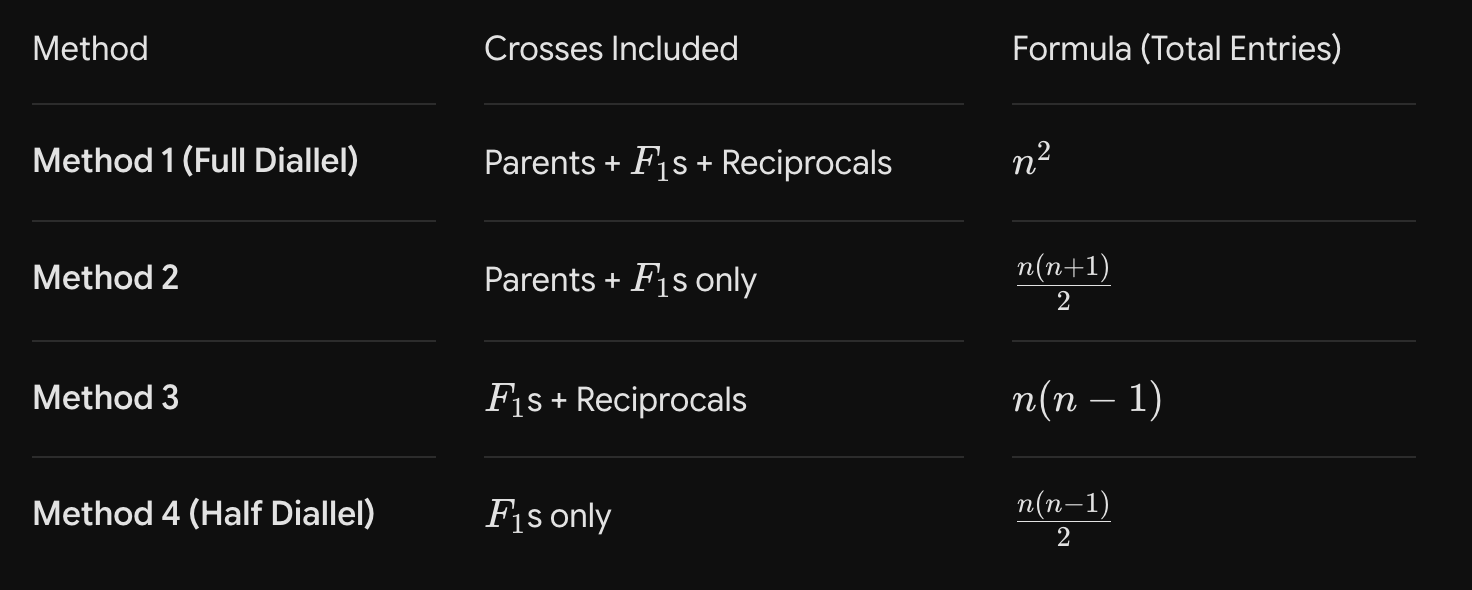
(Note: Method 4 is the most practical and widely used. For 10 parents, it requires only 45 crosses, compared to the 100 crosses required by Method 1).
D. Line x Tester Analysis
- Formalized by Kempthorne in 1957, this is arguably the most practical method used in countries like India for evaluating large batches of lines.
- How it works: A set of female lines ($p$) is crossed with a smaller, selected set of male testers ($q$). The total number of crosses is simply $p \times q$.
- The Goal: It efficiently provides estimates of both GCA (by looking at the main effects of the lines and testers) and SCA (by looking at how specific pairs interacted).
E. North Carolina Designs
- Developed by Comstock and Robinson in 1948, these are highly mathematical mating designs used to break down the exact type of genetic variance happening in a population.
- NCD I: p males are each crossed with q randomly chosen females. This estimates Additive Variance (GCA).
- NCD II: A complete factorial cross of p males and q females. This estimates both Additive and Dominance Variance (GCA and SCA).
- NCD III: A complex design where the hybrid offspring are backcrossed to their original parents. This is used specifically to measure Epistatic Variance (complex gene interactions).