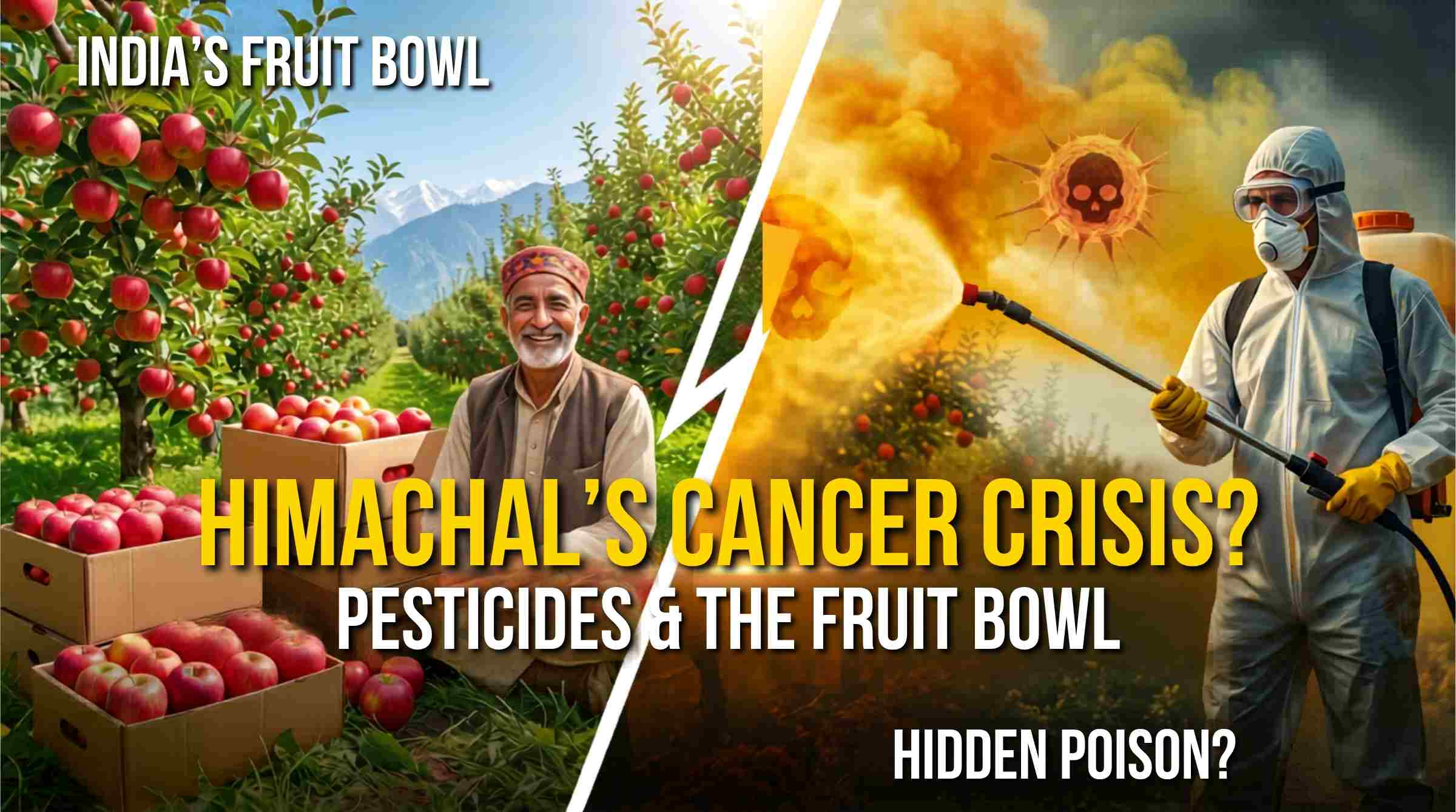
To understand the scale of this issue, we only need to look at Himachal Pradesh. Widely celebrated as India’s "fruit bowl," the state is central to the ecological imagination of the Himalayas. Yet, behind the sprawling apple orchards of Shimla, Kullu, and Kinnaur, and the lush vegetable belts of Solan, lies a largely unacknowledged crisis driven by a deep reliance on Highly Hazardous Pesticides (HHPs).
Here is a breakdown of why intensive agrochemical use has become a severe threat to farmers, public health, and the environment, and what it means for the future of Indian agriculture.
The Illusion of the Green Orchard
The agrarian struggle in high-altitude fruit belts is distinct from the traditional farming challenges seen in the plains. Cultivating high-value cash crops—like apples and off-season vegetables—demands an intensive use of agrochemicals. To prepare land for monsoon-season peas, farmers routinely clear commons and forest land using powerful herbicides.
Because of the high stakes and vulnerable nature of these crops, repeated spraying of multiple chemical formulations has become the norm.
"By the time the apples are ready for harvest, I have already sprayed at least 10 or 12 times, and it is a growing concern year by year," notes a 65-year-old farmer from Kullu’s Banjar Valley, who has over four decades of orchard experience.
Because of this sheer frequency of application, the occupational exposure faced by the agricultural workforce is exceptionally high. What begins as an occupational hazard—extreme fatigue, severe eye irritation, skin lesions, and acute systemic toxicity—quickly compounds into a wider public health disaster.
A Public Health Emergency
The epidemiological fallout of this intensive HHP cycle is staggering. The suffering of farmers has, unfortunately, been normalized as simply "the price of cultivation." However, medical data reveals a deeply concerning trend.
| Health Indicator | Himachal Pradesh | National Average |
| Cancer Mortality Rate | 9.5% | 7.7% |
| Annual Cancer Growth Rate | 2.2% | 0.6% |
The state is not merely following a national trend; it is accelerating past it.
Leading oncologists have called for strict regulatory laws, and institutions like the Indira Gandhi Medical College and Hospital and Himachal Pradesh University are actively researching the extent of this contamination. The lethality of these chemicals is hard to overstate: in the Shimla division alone, forensic records documented 585 deaths linked to agricultural pesticides and phosphine compounds over just five years.
The Paraquat Problem
At the center of the global pesticide debate is Paraquat, a highly toxic herbicide.
Due to severe concerns over human health, environmental contamination, and occupational exposure, Paraquat has been banned or severely restricted in more than 75 countries. Even its principal global manufacturer has announced a phase-out of production. Yet, the chemical remains widely available in several Indian agricultural regions, illustrating a severe gap in regulatory oversight.
The Ecological Tax: Soil, Water, and Bees
The devastation caused by HHPs does not end at the hospital doors; it quietly dismantles the environment.
-
Water Contamination: As the "water tower" of North India, the Himalayan ecosystem is uniquely sensitive. Peak pesticide application often coincides with heavy rainfall. These rains wash toxic chemical loads directly off the farms and into local mountain streams (khuds), poisoning downstream water sources.
-
The Fertilizer Trap: Beneath the soil, routine drenching with systemic HHPs destroys beneficial microbial diversity. When natural nitrogen-fixing bacteria are killed, soil fertility plummets. This forces farmers to buy more synthetic fertilizers every year just to maintain baseline yields.
-
Pollinator Collapse: Himachal Pradesh’s apple economy relies entirely on insect pollination. However, indiscriminate HHP use is decimating local bee populations. To save their harvests, farmers are now forced to rent commercial bee boxes at high costs—a human-made "ecological tax" to replace what nature previously did for free.
The Way Forward: A Regulatory Reset
The growing body of evidence from toxicology, public health, and environmental research makes one thing clear: the risks of Highly Hazardous Pesticides cannot be managed simply by printing "safe-use instructions" on a label.
To secure the future of Indian agriculture, a multi-pronged approach is required:
-
Strict Phase-Outs: The immediate strategy must be a state-led regulatory reset, starting with the ban of the most lethal HHPs—particularly those with high ecological persistence or no known antidotes. International evidence shows that removing these pesticides dramatically reduces rural mortality without harming agricultural output.
-
Viable Alternatives: A ban is only half the solution. Farmers need active support to transition toward resilient horticultural crops and scale up Integrated Pest Management (IPM) and Integrated Weed Management.
-
Policy Synergy: This transition must integrate with existing holistic health and agricultural mandates. Initiatives like the Khet Bachao Abhiyan (rescuing farmland from degradation), SEHAT, and state-specific missions like the Prakritik Kheti Khushhal Kisan Yojana (Natural Farming Initiative) are vital.
A transition to natural farming cannot take root in soil already contaminated with chemical residues, nor can it succeed if natural pollinators are systematically weakened. Phasing out Highly Hazardous Pesticides is not a constraint on agricultural growth; it is the absolute precondition for its survival